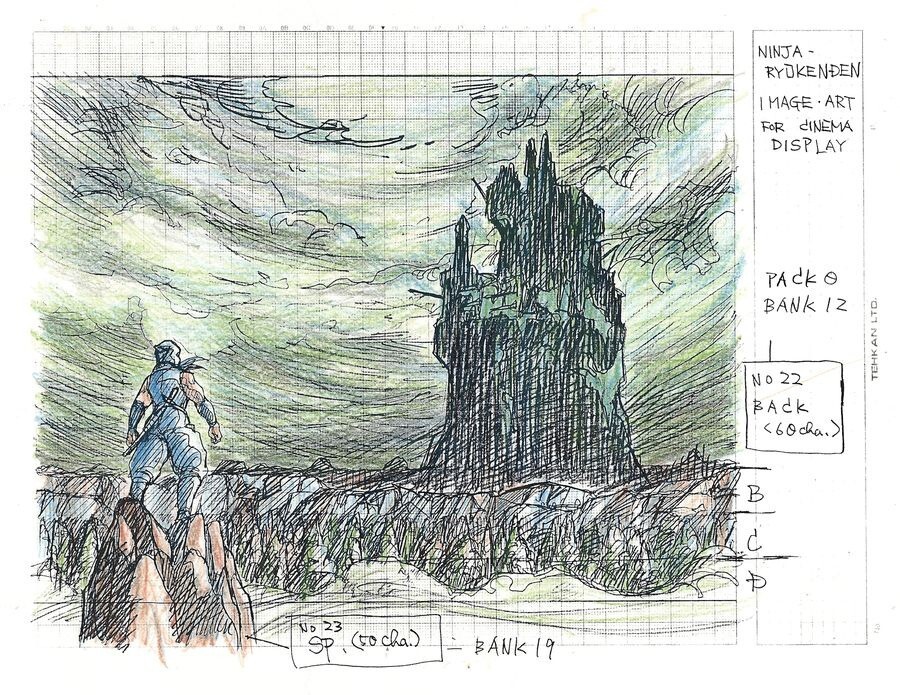
Tecmo’s president wanted two games called Ninja Gaiden, one for arcades and one for the Famicom. He did not require them to play alike. In the third part of a retrospective interview, director and producer Hideo Yoshizawa recalled how he and the arcade game’s lead agreed to go their own ways. What looked like an arcade port was a game Yoshizawa had conceived for the home console, with a story told through cinematic sequences at the opening and between stages.
The arcade designer, whom Yoshizawa identified only as “I,” had a particular controller in mind: a grip-shaped joystick with a button under the player’s thumb. It let the ninja hang from objects or perform a throw. A distinctive control panel could catch someone’s eye in an arcade and command a higher price when sold with the game. Yoshizawa, meanwhile, told his colleague he wanted to make Ryu Hayabusa look cooler in the Famicom version. His colleague had no objection, and neither interfered with the other’s project. Yoshizawa credited Tecmo’s hands-off management with giving them that freedom.
A swimming stage that stayed on paper
Nintendo had two roles in the Famicom game’s release. At a trade show for wholesalers and distributors, it chose Ninja Gaiden for a central display, helping the game attract orders for 300,000 copies, Yoshizawa recalled. Nintendo also tested the finished software before manufacturing and packaging the cartridges.
Its internal testing group, Mario Club, found no bugs that prevented players from progressing. The testers did, however, suggest an underwater stage where the ninja could swim. It was too late to add a stage, Yoshizawa said, but his objection was also about how it would feel to play: swimming would slow a game built around quick movement.
Ninja Gaiden launched first in Japan, where Yoshizawa put sales at about 300,000 copies. His former supervisor, Kazutoshi Ueda, invited him to dinner and singled out the stylized story sequences as the reason he thought the game had sold so well. For Yoshizawa, the surprise was that someone had noticed the work he most wanted to pursue. He recalled that the conversation made him want to develop that sensibility and find other ways to use it in games.
What changed overseas
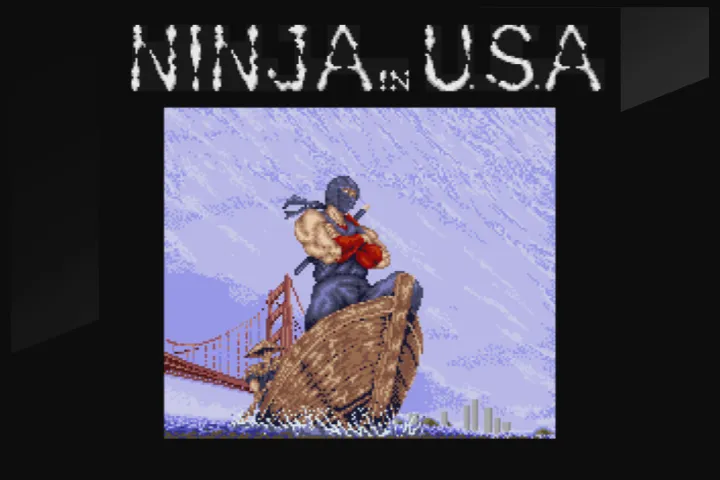
For the English edition, Yoshizawa and artist Kato reviewed an outside company’s translation and met the translator to discuss details of the story. The translator was Daniel Kahl, later known for his television appearances. Yoshizawa remembered Kahl slipping into Japan’s Yamagata dialect in conversation and listening closely as the developers explained the scenes. One deliberate change was to Ryu’s father: called Joe in Japanese, he became Ken in English, after the president of Tecmo’s American operation.
The US television commercial had its own idea of a ninja story. A child dressed as a ninja crawled past his television-watching parents to recover a confiscated cartridge, climbed to his upstairs bedroom and tossed it into the NES like a throwing star. In Japan, the commercial had instead featured a ninja fighting through the rain-wet streets of Hibiya, filmed late on a Saturday night with an English voice-over.
When the NES game reached the United States in March 1989, Yoshizawa was in Japan working on his next project. Word was slow to reach him. He eventually received reports of queues, stores selling out and customers going from shop to shop in search of a copy. Tecmo ordered more cartridges, but an order took about three months to ship. Despite his concern that interest might fade in the meantime, Yoshizawa said US sales continued to grow, ultimately reaching about 1.5 million copies. The success prompted Tecmo’s president to float the idea of a Steven Spielberg film. Yoshizawa liked the suggestion, but nothing came of it.
Europe’s PAL television standard posed a different problem: without changes, the game would run at five-sixths of its Japanese and North American speed. There was not enough time to adjust and test everything, so the team restored Ryu’s movement to its Japanese speed and left the enemies moving at five-sixths of theirs. Playing that version, Yoshizawa found the difficulty felt just right. He stopped short of calling it better, though: for players who had mastered the original, the faster enemies helped give Ninja Gaiden a rhythm they could not find elsewhere.